Wednesday, September 18, 2013

Following Our Professional Dreams?

When I was about 16 years old, I came home from high school and told my mother that I had decided I would major in English when I got to college, that I would then move on to get my MFA in poetry/creative writing and that I would teach creative writing at the college level.  I knew what I was going to be when I grew up.

As a teenager, though, being a creative writing professor, or a writing professor in general, embodied one very cool professor I had freshman year of college. David Trinidad was a cool guy who wrote cool poetry and wore cool scarves and got to talk about poetry every day.  He was my hero - someone who had made a living off of poetry, when my blue-collar uncle had said to me years before, "Poetry?  Please.  Poets don't make any money. You can't be a poet."  The writing professor was a being to aspire to.

I am a writing professor now.  Primarily, I don't teach creative writing but rather composition.  Had you ever told me years ago, when I was drowning in Expository Writing at Rutgers, that I would be a composition expert, I may have told you that you were actually insane.  If I could have looked into a crystal ball and seen myself presenting on hybrid composition teaching at conferences, publishing articles in publications focusing on college composition, I may have checked to see if there was a large and quite tell-tale bump on your head, denoting an obvious concussion.  But here I am. And I love it.

I have found that it is all writing that moves me, not just poetry.  I have discovered the beauty of a well-written argument, of the student who has never felt successful at writing but does after completing my class, of the discussions involving the rhetoric we present in our classes.  I have transformed myself into not just a poet, but a composition expert, a hybrid expert, someone who actually researches and cites and works hard to teach my students how to present themselves in the real world.  Who knew?

This bridge between the creative writer and the composition writer is one that I have recently delved into in an article published in the CCCC Forum, Fall Issue 17.1.  In the article titled, "My Terminal Degree is Better than Yours:  A Brief Examination of the Creative Writer as Contingent Faculty," I explore the dichotomy between comp and creative.  Feel free to read it for more on the NCTE site.  


What do you think?  Can we be both?

Wednesday, July 24, 2013

Getting Lost Over the Summer

I always teach in the summer.  ALWAYS.  This summer, though, due to lack of enrollment, that is not the case, as mentioned in a previous blog post.  Now, I'm more than halfway into this "first summer I have not worked since I was 16 years old" and here's what I have to report:
  • It is quite easy to get lost in your head in front of a computer when you do not have any hard deadlines.
  • If you write enough prose poems in a row, everything you write, every email, Facebook status, blog post, seems like a prose poem.
  • Writer's block doesn't happen to me when I don't have a million papers to grade, a million emails to respond to, a million questions to answer.  That's right. I have conquered him, that mean old Block. Apparently, all it takes is some free time.  Who knew?

  • Gardening is fun. I mean, really relaxing and fun.  My porch currently looks like a suburban jungle.
  • Anyone who tells you they do not start preparing for their Fall semester courses until the end of August is a damn liar, or, alternatively, my nemesis.  My unfinished syllabi are already haunting me in my sleep.
  • Life at the university goes on when I am not there.  Really.  I went there a week or two ago for a technical training session and I got a parking ticket. Business as usual.
  • There are two ways to get your work published:  Write a lot and submit a lot.  There is no easier way.
  • Apparently, contrary to mid-semester belief, my house does not clean itself.  And the more time I spend in it, the more I realize what needs to be done.  I bought 9V batteries for smoke detectors today.  Okay, so maybe I have a little bit of writer's block.
  • Every now and then, I check my email for no reason at 11:00 on a Sunday night and feel a pang of sadness when I see I do not have 75 students freaking out over an assignment due in an hour and I have no one to comfort, no one to console, no one to direct.  Then, I realize that  I have no one to comfort, no one to console, no one to direct.  And I smile. 
  • Finally, and most importantly, I love my job.  I think about it when I am not doing it.  But this summer at least, I love poetry more.


Thursday, June 6, 2013

Negotiating Summertime - Three Steps

I grade essays.  Lots and lots of essays.  I have a system for doing so and the nights that I am up until the wee hours reading arguments about poetry are very familiar to me - quiet living room, sleeping husband, bad '90s sitcoms on mute on the television.  Each day of the week, I negotiate with myself as to how many essays I can get done before dinner, between dinner and bed, maybe even between the morning workout and the commute to campus.  I calculate how many minutes each essay will take and each time, undoubtedly, underestimate that length.  In short, grading essays is a part of my life.


I have always taught summer classes, leaving little room for any period of time not grading essays. That's okay; I'm an educator and this is my job, right?  This year, though, my summer class got canceled.  Canceled.  And so begins my journey into not grading, not negotiating grading timetables, not watching Full House on mute at two in the morning.  

How will I do this?  I have a lot of time on my hands.  And yes, I have other projects planned for the summer, projects that will most likely make me some money and keep me relatively busy.  The problem is, I am used to responsibilities that include a constant cloud of essays hanging over me, waiting to be graded, evaluated, sent back for revision.  Any project I choose this summer, and there are many, will not create this kind of schedule.  I will have to adjust. I will have to figure out how to do this.

So, here are my steps.  

1.  Read.  

I know. This sounds counter-productive.  I spend the entire academic year reading; why continue?  Personally, I just cannot let my brain turn to mush.  I need stimulation.  I need thought.  So, I read.  I read romance novels and entertainment magazines and bestsellers and poems and book club books and articles about student loan debt.   I find myself watching Jeopardy religiously just to prove to myself that I can still rock out the American Literature category. It helps. I think.


2.  Take the time to remember why you were motivated in the first place.

It's easier said than done.  When we spend ten months saying, "Once I get a break, I'll write that article" or "I'm going to start that small business if it kills me" or "That novel is not going to finish itself," we are all gung-ho when that break comes.  You grab a cup of coffee and are seated in front of that crisp, white, empty Word document by 8:00 am.  You're going to change the world.  And then, you get distracted - by Facebook, by videos of kittens playing with string, by the internet in general and all of the ridiculousness it has to offer.  Why have you lost that motivation?  Because you're tired!  This seems like a time for a little self-reflection, a break, possibly even (gasp!) a vacation.  No one says you have to go party in Miami.  Maybe sit in a bookstore for awhile and stare off into the sea of people around you, or visit relatives, or drive to the beach by your lonesome just to sit.  You'll remember, sooner or later, upon reflection, what it was that made you so gung-ho in the first place, and you'll be more productive for it.


3.  Stop being so mean to yourself!

Listen, we all feel like we should be doing more after two semesters or more (I haven't had a summer without at least one class in five years) of grading and teaching like superstars.  But it's okay to have a glass of wine at four in the afternoon on a Wednesday when you have no papers to grade and some old episodes of Twin Peaks bookmarked on your Netflix.  It's okay to take an entire day (!!) to do NOTHING AT ALL.


(I just couldn't resist my favorite Simpsons line there!) So relax; take it all in.  Summer is happening, whether you're teaching or not.  Enjoy it.  Write something.  Read something.  Research something.  Or, do nothing at all.  Ned Flanders would approve.

Friday, May 17, 2013

Facing Plagiarism with a Positive Attitude?


**This blog was originally posted on "Deep Down in the Classroom," a blog maintained by the Montclair State University First Year Writing Program, which can be viewed here.


I don’t know about all of my fellow educators, but I certainly found some plagiarism as this semester wound down.  A couple of weeks ago, particularly, an essay came back from Safe Assign with a 70% rate of plagiarism. It was a documented essay that was two pages short of the minimum length requirement with no citations or sources.  The essay was almost completely taken from two blog posts.  Disheartening does not begin to describe it and meeting with the student to discuss this absolute blatant abuse of the internet as information provider was truly no picnic.
I know that this is a discussion that educators have frequently and I appreciate that many of you are probably tired of discussing it.  However, in my absolute desperation, I have been reading articles online that address the issue, and I found one in The Chronicle of Higher Education that, although from September of 2012, addresses plagiarism as something that requires that “the solution should be positive; that is, show students how to act as responsible scholars and writers. The same tone should be reflected in the syllabus. [The author says he has] seen many syllabi in which the penalties for plagiarism are laid out in excruciating detail, with no positive models or behavior mentioned. Surely by now we know that positive motivation trumps the negative variety” (Karon).  Of course, many of us find this difficult, as the absolute frustration takes over and we feel like our students will never care about the ethical implications of “borrowing” work from other writers, scholars or random yahoos online who write blog posts and therefore, must be credible.
I guess I am writing for two reasons.  First, I would like to hear how all of you have dealt with this over the course of our current academic year.  How do you distinguish intentional from accidental?  Second, I would love to hear solutions for prevention.  Should we not allow any sources that do not come from the University Library?  Will it make a difference, when students don’t cite many of these sources anyway?  Finally, how do you stick to your guns?  I find that when faced with a crying student, I have to steel myself to the tears and really make myself stay strong in order to make sure that the student learns from the experience and grows into a ethical adult and writer in the future.
I know we’re all busy and you probably don’t want to discuss that which upsets us so much, but your insights are invaluable.  Plus, it will be nice to get emails that are not grade complaints or appeals for leniency.  :)
Here is the link to the article and, in the interest of academic honesty, the MLA citation.
Karon, Jeff.  ”A Positive Solution for Plagiarism.” The Chronicle of Higher Education. 18 Sept. 2012.  Web.  2 May 2013.

Tuesday, March 26, 2013

You Kill Me, Robert Frost

It is early afternoon, hours before I feel that I can actually turn my mind off, and I am reminded of the great Robert Frost, who's birthday it is today.

The woods are lovely, dark and deep.
But I have promises to keep,
And miles to go before I sleep,
And miles to go before I sleep.

This is one of my favorite stanzas in all of poetry.  The simplicity of it, the normalcy, jars me.  Robert Frost, writer of great, widely misinterpreted quatrains, writer who dominates my students' choices for subjects of research papers, had obligations too.  He probably sat there on a Tuesday afternoon with a sore tooth and a cold cup of coffee muddling through the creation of what he hoped was useful feedback too. He was just like me.

Of course, I am no Robert Frost.  I am just a college writing professor, a selectively published poet, a woman with 75 empty grading rubrics and a queue of 75 essays that need to be paid careful attention.  But I find this parallel, this reminder of normalcy and obligation, comforting in this land I call the middle of the semester, a place where I often forget to come up for air.

Midterms can be a scary place filed with deadlines and grade complaints and committee work and the plain old grading that comes with being a teacher of writing. But today, Robert Frost and his small concession to a perfectly normal desire for sleep offered me a realization that is actually priceless in today's "get it done fast" world. I realized I could sleep if I wanted to. I could sleep and I could go for a run and I could bake healthy cookies with agave instead of sugar and I could do all this even if I felt like I didn't have time because really, who wants to count the miles they have to go before they can sleep?  

And really, you'll find a way to get it done anyway.  You always do, don't you?  Go for a run.  Enjoy the sunlight.  Take a break.  Eat a piece of chocolate.  Keep your promises to yourself as well as everyone else. Be a person and a professor. It's okay.  I think that we've all earned a random hour or two to ourselves.  This evening, I'm going to spend mine with a novel.


Friday, February 8, 2013

Poem Published!

My poem, "He Told Me" (dedicated to Langston Hughes) has been published in OVS Magazine's Winter issue.  You can check it out here.  

This is a great magazine and a wonderful group of people run it.  I am happy to be included and even more excited to read the other work in the issue.  

For every 10 or 20 or 50 or 100 rejection letters, there lies a publication that will appreciate your poetry for what it is - your best work.  Thank you, OVS, for recognizing a poem that I love more than many poems I have written, more than warm blankets in snowstorms, more than white wine and scallops, more than any of the terrible pieces I have written and scrapped. 

What a validating feeling, to see your work in print.  Celebration!

Sunday, February 3, 2013

Teaching Development: The Evil of Page Requirements

As a writing professor, I often have students who struggle to reach the required amount of pages for their essays.  In writing classes that students must take, regardless of major, many of them are just beginning to find their voices in academic writing.  They straddle an interesting line; either they are too wordy, too redundant, in order to meet that length requirement, or they have not come up with enough content to meet the requirement without being too wordy or too redundant.  They are upset that they can't get to five pages or they are upset that they did get to five pages and I told them it wasn't good enough.

Paul McHenry Roberts wrote one of my favorite essays about student writing:  "How to Say Nothing in 500 Words."  He touches upon many subjects but mostly, he addresses the fact that students do struggle to create intelligent and effective content and do not understand when they stretch their prose out to within an inch of its life to reach five pages that they do not get straight A's.  He wants students to use five words where they may have used ten words before, to say, "He was a fool" instead of, "It seems to me that he acted in a foolish manner."  But how do they meet the requirements of the assignment by using so few words?  How can concise writing actually fix the problem?


I think the major challenge here is creating content.  Students resort to wordy redundancy because they don't have any other ideas. They believe they have nothing else to write about, so they stretch out what they have. And hey, I was either an English or writing major for 8 1/2 years; I know all about changing fonts to make the essay longer and using ten words when I could have used three.  The trick is to find more to write about, but how?

It's easy to tell students, "Don't give up!  Go back to the brainstorming stage to come up with more content to support your central claim." But this is often an impossible instruction.  Many students are either unaccustomed to the process of brainstorming or they are unwilling to put in the extra work.  You can show them as many clustering webs and perfectly formatted outlines as you can find, but still, when left to complete this process on their own, they may feel frustration, confusion or just plain boredom.  They don't always have fully developed skills of analysis and therefore are unable to tell if the ideas they do come up with will be effective in proving their claim(s).  It's a confusing cycle and one that I think many educators struggle with as well.

So, how do we teach development in academic essays?  Are there any exercises you all use to help students to develop their existing ideas or to come up with new ones?

I have one that has been passed around between professors at a couple of the universities where I have taught.  There are different incarnations of it.  I believe I first heard it in a faculty workshop with  Jay Dolmage, author of How to Write Anything, which was, at that time, being used in freshman composition at that college.  It's a revision exercise.  The idea is that you let each student roll two dice.  The number they roll is the number of words they can keep from the original draft; they must use those words to start over.

I have revised it a bit, allowing my students to keep sentences instead of words,. but I have found that this aids in developing their ideas, because when they are only staring at like eight words and the rest of the essay is not there to create bias or to impede the creative flow, new ideas form.  They can then merge these new ideas with the original draft and (voila!) development occurs. In a perfect world, in an ideal and willing class, of course.

Are there solutions?  Tricks of the trade?  Exercises?  Power points?  What do you know that you can share?

How do we teach development?

Tuesday, January 22, 2013

The First Day of Classes - and the Jokes That Fall Flat

I consider myself to be a pretty funny person.  But you just never know what will make students laugh and stop being so freaked out by the 6 page syllabus weighing down their desks.  They are sweating the attendance policy, mentally configuring what their schedules would look like if they dropped my class.  And all I want to do is break the tension.  

This is harder than it sounds.  They don't want to laugh at my jokes and admit that maybe, just maybe, it's okay to stay in a difficult class because the professor might be cool.  They are cold (hey, you try trekking across campus to my icebox of a basement classroom one day!) and they are tired (it is the first day, after all) and all they want is for me to stop talking, give them homework and send them on their way. 

So, I use a Homer Simpson reference to break the ice. Usually, Homer does it.  These students cannot remember a world without Homer Simpson so I figure I am in the clear (unlike when I mention ALF or Happy Days, both of which clearly show my age).  I give the reference...


...and this is how my students react:


I'm trying here; I really am!  Today was rough.  A few snickers at the Hunger Games reference (probably just because they can't believe I know what they read), and I'm done for the day.  Getting them to want to be here is usually a little easier than this.  

The point here is, I am trying to get them to engage and the usual tricks just didn't work today.  Ice-breakers galore and all of my previous training is still useless.

But I will get them to love books!  I will! (says every literature professor in America on the first day of classes...)

Sunday, January 20, 2013

Drums for a Good Cause

As you may or may not know, I am from New Jersey.  I was born here, I grew up here, I live here and I work here.  So you can imagine that Hurricane Sandy hit close to home for me.  I saw the ugliness of homes ruined, livelihoods washed away, and I saw the beauty of communities that banded together to take care of each other, complete strangers breaking their backs for days.

A good friend of mine, a fellow New Jerseyan, drums for the ska-punk band Streetlight Manifesto and he is auctioning off his custom Dark Horse Percussion Drum Kit to raise funds for Hurricane Sandy Relief.  Please consider bidding and also sharing this auction with others.

Thank you!

Friday, January 11, 2013

Guest Editor

I have just learned that I will be a guest editor for the Summer 2013 issue of OVS Magazine.  Please feel free to check out their site and previous issues.  

I will have a poem published in their upcoming Winter issue and will then serve as guest editor in the Summer. I am thankful to OVS for including me in their process and I look forward to it! Here is the current issue.  Check it out!


Wednesday, January 9, 2013

The Least Stressful Job in America?

Recently, I read an article on Forbes.com claiming that CareerCast has calculated that university professors have the least stressful jobs in America.  Allow me to address this now that I have calmed down and am no longer throwing darts at a picture of the writer as I cry tears of happiness all over my final grades for the Fall semester.  

The original Forbes article can be found here,  Before I get into my opinion, I would like to note that professors all over the country and possibly the world have complained about this gross understatement of our responsibilities.  Of course, I by no means have the most difficult or stressful job in America.  So I would, of course, like to start out by saying that I love my job and that I am not complaining about it; I am just addressing the horrid lack of research in this article and the misconception that we all took these jobs for summers off and lazy days on the couch.

In this article, the writers mentions, "At the end of the day, people in these professions can leave their work behind, and their hours tend to be the traditional nine to five."  Woah, slow down there, buddy.  I'm not sure I know even one professor who does not take his or her work home.  As a writing professor, I sometimes have to grade 50-70 essays per week, or even within a 3 day period.  I answer emails constantly and am actually thinking about just ignoring the email on my smartphone for a period each day to alleviate the stress of constant connection.  (But let's not kid ourselves; that will never happen and in fact, the connection will become even more apparent as more and more students get smartphones themselves.)  Among other misconceptions in this article are:

  1. University professors do not answer to anyone.
  2. We are off in the summer.
  3. Universities adding more adjunct positions over the next 7 years is a good thing.
Of course we answer to someone!  In some universities, professors do not even write their own syllabi.  (Check out the University of Phoenix online program; I can assure you that professors there have very little leeway.)  There is a Chair. There is a Dean.  There are colleagues who expect of you what they put in - the hardest work and most concise attention possible.  In addition, even if we do not teach in the summer (and let me tell you, many of us not only teach but get quite upset when there are no classes available to teach) we are doing research, writing articles, trying to publish (and much of the time, collecting rejection letters like pennies), preparing for classes and trying to improve our teaching.  Finally, why not add more full-time positions so that the roving adjunct is a thing of the past?

Real Grading


To the writer's credit, she did write an addendum to this article after MANY university professors spoke out.    But even in that addendum, she underhandedly insults the position when she says, "While I characterize their lives as full of unrestricted time, few deadlines and frequent, extended breaks, the commenters insist that most professors work upwards of 60 hours a week preparing lectures, correcting papers and doing research for required publications in journals and books." So, she still characterizes us as lazy, but hey, she's been confronted, so let's give them what they want.

I think that what most professors want, and most educators in general, is simply for the hard work they do to be appreciated.  Speaking for myself, I do not mind the hard work and I love watching my students learn and grow.  I enjoy presenting at conferences and being a part of the academic world.  And yes, I do get some time to vacation or to watch Downton Abbey during my breaks.  But after working 70 hours a week during the semester, can you blame me for wanting to escape into 1912 England for awhile?  But aside from all of this, it is the positive comments from students, the acknowledgement of hard work from superiors, acceptances to publications and conferences, that lift me up and make me realize the world of good that I do, or try to do, on a regular basis.  It would be great if the writer could answer this one question: 

Do you find it not stressful to make sure that young adults actually turn out to be successful in the global community?

The internet, understandably, has been buzzing with the fallout of this article for about a week now. As a result, new Twitter hashtags have been created and new articles to go against this silliness have been written. Forbes even published "Top 10 Reasons Being a University Professor is a Stressful Job."  So, after finally writing about this myself and admitting that yes, my job does rock but that does not mean I am without stress, (and please stop making my students think my job is so cushy, as you have no idea the repercussions of such ignorance), I am putting it aside.  But I would love to hear from my fellow educators.  Please feel free to comment when you are taking a break from syllabi preparation, as we all know that's what you're doing right now.


Friday, December 21, 2012

Poem Acceptance

I am happy to report that one of my poems, "He Told Me," has been accepted for publication in the upcoming issue of OVS Magazine.  This is a great literary magazine that brings literature and visual art together.

Feel free to check them out here.

I will keep everyone updated about when it comes out and where it's available.  But for now, please enjoy one of my favorite John Ashbery poems - a poem about poetry.


Paradoxes and Oxymorons
by John Ashbery

This poem is concerned with language on a very plain level.
Look at it talking to you. You look out a window
Or pretend to fidget. You have it but you don’t have it.
You miss it, it misses you. You miss each other.

The poem is sad because it wants to be yours, and cannot.
What’s a plain level? It is that and other things,
Bringing a system of them into play. Play?
Well, actually, yes, but I consider play to be

A deeper outside thing, a dreamed role-pattern,
As in the division of grace these long August days
Without proof. Open-ended. And before you know
It gets lost in the steam and chatter of typewriters.

It has been played once more. I think you exist only
To tease me into doing it, on your level, and then you aren’t there
Or have adopted a different attitude. And the poem
Has set me softly down beside you. The poem is you.


Thursday, December 20, 2012

Submitting Final Grades Before the End of the World

Well, here it is - the end of the semester.  Finals have been studied for, papers have been written.  Professors are gathering their strategies for dealing with grade complaints; students are gathering their things and heading home to celebrate the holidays with their families.  My world is filled with final portfolios and urgent student emails.  Until this morning, I forgot that tomorrow is the end of the world.

(http://www.mylot.com/w/photokeywords/mayan+calendar.aspx)

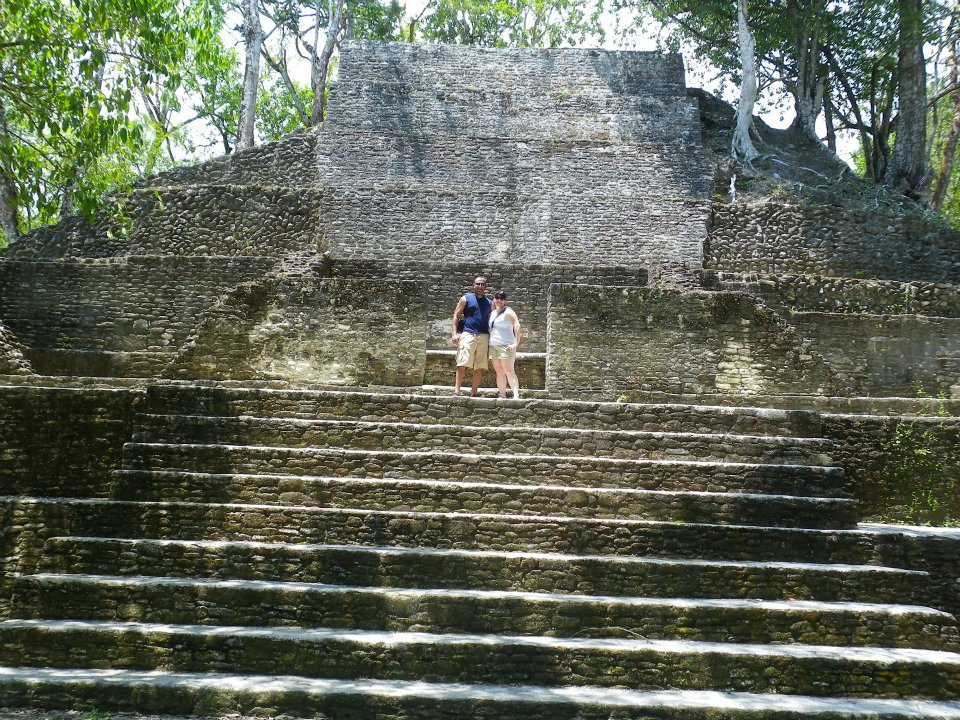
Don't get me wrong - I'm not a believer.  I was in Central America this past summer and the tour guides at the Mayan ruins  were completely unaffected by the possibility that the Mayans had predicted the end of the world.  They were skeptical, but happy; after all, they make money off of those of us who want to see the ruins and question the mysticism of a culture long-gone.  But even with no batteries in the house, no bottled water, I'm working hard to get my final grades in before tomorrow.  Why?


Cahal Pech Ruins, Belize - May, 2012

Reason #1:  If they survive, won't students be thankful for their grades and less likely to complain?  I tell myself that life is ultimately more important than a C-, that breath trumps G.P.A.  Idealistic, I know.  Hopeful at best.  And yet, the beauty and strength our country has shown in the past few months, between a "superstorm" that crippled us and a school shooting that took those most innocent and close to all of our hearts, has made me believe the best in people.  So, let me hold on to the belief that my students will appreciate life and allow me to appreciate mine.

Reason #2:  I am completely obsessive about my email.  During the semester, I cannot go a day without checking it.  If grades are not submitted, I can't put an away message up on my email for the end of the world because technically, my students might still need me.  I don't consider my semester finished until I enter those grades into the system.   And who wants to check their email during the apocalypse?  My phone didn't even work after the hurricane; I'm not sure what will happen if alien overlords descend onto our planet and make us their slaves.

Reason #3:  I just want to be done!  Let's be real; saying the end of the world is coming tomorrow is just a reason to be done by the 21st of December, quite early when you consider that grades are not even due until 12/27.  This semester has been rewarding on many levels. I have found myself as an academic and am more confident than ever in my ability to help my students reach their goals.  I piloted a new hybrid syllabus and some essay assignments that I think worked quite well and that I can tweak to perfect before the Spring semester.  I offered feedback until my eyes felt like they were bleeding.  And now., it's time to write out those holiday cards (yes, friends and family, you will be getting those around Christmas Eve because that's the way I roll), wrap those gifts (and I really take pride in my wrapping, so that takes some time), bake those cookies and gather with my friends to watch the end of the world.

After all, if the world is going to end, who wants final grades hanging over their heads?  Not this professor.  Count me as finished by tomorrow - and let me know if you survive.


REM - It's the End of the World As We Know It

Thursday, December 6, 2012

Paper Grading Bingo

 I thought we could all use a way to make those final weeks, days and hours of grading a little more entertaining.  Let's play Bingo!  Meradeth of "A Girl's Guide to Graduate School," thank you for sharing!


If you get BINGO, please let everyone know in the comments section!  And feel free to vent; we all love our jobs, but we have to let it out every now and then. :)

Source: http://girlsguidetogradschool.blogspot.com/2011/03/grading-papers-play-some-bingo.html.

Wednesday, December 5, 2012

When in Academia...Learn to Appreciate the Good Ones

Recently, someone linked me to a Tumblr page called "When in Academia."  I have to say, it is hilarious.


My personal favorite is the one that points out the face one makes "when the very first word of a student's essay is grammatically incorrect."  The image is Neil Patrick Harris looking utterly and completely disappointed.  He is looking down, shaking his head, voicing all of our frustrations as writing professors.  


We have all been there.  There's that student - the one who comes to office hours and who sends you emails at all times of the day and night, who then submits an essay that is grammatically weak, to say the least, does not follow any of the guidelines that you put on the assignment or went over in class, and is basically the work of a student who doesn't do any of the things previously mentioned.  It's like he never listened to you in the first place, like he is coming to office hours to make up for the fact that during class time he is off in another world, or sleeping, or, apparently, temporarily deceased.  

The fact is, regardless of all of our good intentions, sometimes students just don't listen.  They don't do the reading and they don't talk in class.  I stand in front of the blackboard, talking to myself in a room full of people, hoping that they remember to read the paper assignment before submitting an essay that makes me sad.

So, I learn to appreciate that great class full of students who do talk.  They have done the reading and they have ideas, real ideas, about what the themes in that reading might be.  They not only read the paper assignment, but they follow it to the letter, double spacing and using direct quotations from the text (formatted correctly in MLA).  They, simply, do what they are supposed to do.  And I look like this:


This semester, I have one of those classes.  The students all seem to be friends.  They come in and greet each other with enthusiasm.  They start talking about the literature before class technically begins.  They relate the literature to their own lives and they wonder out loud about what Thornton Wilder meant when he made Emily Webb go back in time to her 12th birthday.  Their essay grades are not exemplary, but they follow my instructions. They listen. They may not be "A" students.  Many of them are not even "B" students. But they come prepared for the work that college demands of them.  And that, my friends, is worth all of the incorrect citations and ignored instructions in the world. 


Mentioned on the Montclair University Website!

Sarah has been mentioned on Montclair State University's First Year Writing Program website.  

https://www.montclair.edu/chss/news/index.php?ChannelID=239

To read more about the First Year Writing Program, where Sarah is a professor, please visit the above page.  It is an amazing program and a recent recipient of the prestigious CCCC writing certificate of excellence.

Sunday, December 2, 2012

New and Improved Website!

Check out my new and improved website!  While visiting, you will find:
  • Poetry
  • Stories
  • Information about my professional services
  • Testimonials 
  • Information about my publications and qualifications
Have a wonderful day!

Wednesday, November 21, 2012

Managing the Workload of the Composition Classroom

It's Monday night.  I have four classes in a row tomorrow.  Tuesdays are my long day. I must leave my house at 8:00 am to get to my 10:00 am class on time because of traffic. I will undoubtedly leave at 8:15 am, making it just in time, but while punching my steering wheel and unnecessarily hating the people who innocently drive in front of me on the New Jersey Turnpike.  I will then teach until 3:45 pm and battle the Turnpike on the way home once again.  By the time I get home, I will not want to do anything, let alone analyze the central claims of my composition students.  So, I have to get these 30 essays graded tonight.

I begin to panic.  "I can't get it done," I think.  "I can't get it done without losing my mind."  Then I start to negotiate with myself.  "Maybe if I get 20 essays graded tonight, I can fit in 10 tomorrow in between classes and finish off the rest when I get home."  Then, I start to calculate.  "Well, if I spend 15 minutes on each essay, that's 450 minutes total, which is 7 1/2 hours. I will work for 5 hours tonight and 2 1/2 hours tomorrow." Yes, that should do it.

The problem is, that calculation does not include answering student emails. It does not include taking breaks to eat, or to frivolously browse Facebook; it does not include folding the laundry or watering the plants or writing essay prompts, and I certainly haven't left myself time to write lesson plans for those four classes I have to teach tomorrow.  I'm looking at a very short night's sleep, and a winter break that still seems very far away.

Don't get me wrong. I truly love my job. I love to work with students, to teach them how to write, to watch them improve and to begin to understand the world of academic writing.  I love being in the classroom and I even love reading student papers and watching their ideas take shape. I love writing.  The workload, though, the sheer number of essays, can be staggering at times.  I begin to sound like Prufrock in my head.  "I grow old...I grow old..."

Years ago, when I got my first half-time professorship, a superior said to me, "Sarah, just put grades on those final drafts and be conservative with the comments. They need to learn how to revise independently, and you will have already commented extensively on the first or even middle draft."  This advice runs through my head on a regular basis, and especially during those times when I'm drowning in a sea of incorrect MLA citations with no end in sight.  As a teacher of writing, I feel guilty when I leave short comments. I know, logically, that my superior was right; students must learn to improve their own writing and I must give them room to do so.  But how do we know when we're not doing enough?  How do we gauge when we're holding their hands too much?  

Over the years, colleagues have offered their grading rituals.  Some have shared rubrics and some have shared tips and tricks. (One person told me that she would set a timer for one hour, sit there and do work with no distractions for that one hour and then allow herself a 15 minute break when the timer went off.)  I have attended workshops and I have updated and changed my own process and rubric numerous times.  I think the problem is that many of us don't want to accept it:  Being a writing professor is a time-consuming job that allows you to truly appreciate those lovely breaks that teaching at a university afford you.  In fact, more than I tell myself the essays will never end, more than I search for ways to make grading more efficient, more than I ask friends how they do it, I say to myself, "Sarah, I think you just need to suck it up."  This, more than anything else, seems to work.

Friday, October 5, 2012

Conference and Essay Proposals for Contingent Faculty

Recently, I got an email asking for stories of contingent faculty and how their experiences in the academic world differ from those in tenure-track positions.  The idea of writing an essay proposal and then an essay about this topic appealed to me as I was an adjunct professor for a long time before becoming a full time lecturer at Montclair State University.  My thought is that one of the issues in the world of contingent faculty is the difference in degrees; specifically, although an M.F.A. is considered a terminal degree, those who have them are often passed by for more permanent positions in favor of those who have Ph.Ds.  And this creates the kind of competition that can define the world of academia.

I'm not against good old healthy competition and I believe it motivates us to work harder and to engage with the academic community in a more concrete way - and more often, for that matter.  However, the world of a creative writer - one who can certainly teach academic writing quite well (and we do!) but who's focus is more on creative writing and who most likely holds an M.F.A. is a different world than that of a Ph.D. candidate in rhetoric and composition.  Publishing is an important aspect of being part of the academic community.  For me, however, it has always been creative.  I have had mentors encouraging me to publish in literary journals and to apply for creative grants that require creative publications for years.  I have focused on The Paris Review, The New Yorker, Fence.  My graduate thesis is an 80 page long collection of poetry that I am constantly revising and sending to publishers and presses. I have participated in workshops, Summer programs, applied for grants and fellowships, all based on poetry.  And now, after years of learning how to teach writing, years of working as an adjunct at several different universities in one semester, years of fighting for the full time lecturer position I have now, I am competing against people with academic dissertations who get to be called “Doctor” and get paid more than me because their terminal degree is apparently more accepted than my terminal degree.  And somehow, I have to publish.  And I’m talking in the scholarly world, which is apparently, to use an overused metaphor, a whole different ball game.

The wonderful part of this is, I am embracing the challenge.  I am researching, writing, looking at the issues that my writing students face analytically, using APA format.  I am becoming the scholar that I only touched upon in graduate school in between poems.  My question is, how do other contingent faculty members deal with the expectations, the competition, the divide between creative and academic?


Sunday, September 16, 2012

Grading Essays in the 21st Century.

Well, we are now a few weeks into the semester and for most writing professors, the grading has begun.  Personally, the first draft of the first essay in my class is not due for another week or so, so I have had some time to reflect on the process of grading, the amount of time it sucks from my life on a regular basis, like a yogi taking deep, plentiful breaths, and how I can reconcile my need for personal time with the needs of my students.

It's an age old question.  How do I make time for myself and still call myself an effective educator? As writing professionals, this is difficult, as our grading does not consist of answer keys but of comments - helpful, substantive comments that will help our students to be better at one of the most basic of all professional tasks - writing.  We live in a world where people write more than ever.  Between social networking, blogging, articles, memos and text messages, we are composing sentences and paragraphs at an alarming rate each day.  As teachers of writing, it is our job to help our students recognize a well-written sentence and an incomplete sentence; it is our job to make those Facebook statuses sing.

But how do you do so when your family is coming over for Sunday dinner, your kids have Saturday morning soccer games, your best friend's birthday lands on a Friday night and  you need to clean the house and go grocery shopping - all in addition to the stack of essays or the stacked inbox mocking you at every turn?  How many times can you hear someone tell you to learn to "manage your time" before you want to stick a pencil in their eye?

I have not, by any means, figured this out to perfection.  In fact, I still deal with the odd professor's guilt that comes over me each time I watch a wave from the beach or eat one of my grandmother's meatballs when I could be in front of my computer analyzing my students' central claims.  But I think I have found a sort of balance that lends itself to the 21st century:  Digitize!

Since I started accepting essays only via email, my time has opened up just enough to make me notice.  I think that the main reason for this is that grading on the computer allows for multitasking; I can grade a paper and then update my blog, work on my family's calendar or even teach an online class during those moments when I just can't read another central claim about how Shirley Jackson's "The Lottery" challenges our ideas of tradition and ritual.  I can grade an essay and enter the grade into a my Excel grade book without hunting around the house for my paper grade book or a colored pen.  I can copy and paste a section of a paper that I suspect is plagiarized without having to underline it, retype it and write down the website address where I finally find it.  Whether I like it or not, the world is digital and by grading this way, I am not only allowing myself more free time; I am also allowing my students to submit their work through the medium in which they are most comfortable.

Last year, I presented at the annual NJWA conference and showed the people who attended my session how to use Google's Gmail, and Microsoft Excel and/or Google Drive to create grade books and rubrics as well as organize student emails efficiently. The best part is, it's free!  I am in the process of putting these instructions into an E-book, which will then be published on Amazon.  If you are interested in learning how to do this, please let me know and I will add your email address to my list of people to notify when the book comes out.  The most important thing to remember is that this is the 21st century; we can grade, write and communicate without ever using a piece of paper or one ounce of ink, and doing so can vet us more free time than we ever had before.

Let me know what you think. I would love to hear the experiences of others with digital grading.  And good luck with the first round of papers!